As an Amazon Associate I earn from qualifying purchases. It doesn't change what I recommend.
I spent more than ten years as a competitive swimmer, where 5am sets after short nights were normal. These days I work 12-hour rotating shifts, and I have a genetics degree that makes me read the methods section before the headline. So when people on my crew ask me is creatine safe, and whether it can help on a night with almost no sleep, I wanted a proper answer rather than a gym rumour.
Here's what the research actually says about creatine side effects, the much-shared "no-sleep" study, and a newer follow-up that most people haven't seen yet.
Why shift workers keep asking about creatine
Creatine is one of the most researched supplements in sport. Your muscles and your brain both use it to recycle ATP, the molecule cells spend as energy. Sleep loss drains that energy system in the brain, which is part of why 4am on a night shift feels like thinking through wet sand.
That link is what made a 2024 study from Germany go viral: researchers asked whether a single dose of creatine could soften the hit of a sleepless night.
What the sleep-deprivation studies found
The 2024 study. Healthy adults stayed awake for about 21 hours. Partway through, they took either a placebo or one large dose of creatine monohydrate (0.35 g per kg of body weight), then did cognitive tests and brain scans over the next several hours. Compared with placebo, creatine improved cognitive performance and processing speed, and the scans showed changes in the brain's high-energy phosphate levels and pH, a sign the brain's energy supply was being supported (Gordji-Nejad et al., 2024).
The 2026 follow-up. The same research group then tested a lower single dose, 0.2 g per kg, in 29 healthy people over the same 21-hour sleep loss. Creatine still reduced the drop in logical and numerical tasks, language processing speed and a reaction-time test called the Psychomotor Vigilance Test. The effect was smaller than with the high dose, at up to about 12%, and women benefited more than men on several tasks (Gordji-Nejad et al., 2026).
That's genuinely interesting science. But before anyone tips a heaped scoop into their pre-shift shake, look at the numbers.
The catch: those doses are big
For an 80 kg person, 0.35 g/kg is about 28 g of creatine in one go, and 0.2 g/kg is still about 16 g. The well-studied everyday dose is 3 to 5 g a day. So the trials used roughly three to six times a normal serve, all at once.
That matters for three reasons:
- Safety data mostly come from normal doses. The big reviews on creatine safety are built largely on 3–5 g a day or split loading doses, not single 16–28 g hits taken in the middle of the night.
- The test was a lab, not a ward or a worksite. One night of acute sleep loss in healthy volunteers isn't the same as months of rotating rosters.
- The samples were small. Promising early results need replication before they become advice.
Is creatine safe? What the big reviews say
In 2021, an international panel of creatine researchers reviewed the most common fears, and in 2024 they published a second part covering newer questions (Antonio et al., 2021; Antonio et al., 2024). In healthy adults, their findings line up like this:
- Kidneys: at recommended doses, creatine hasn't been shown to damage kidney function in healthy people. One practical point: creatine can raise creatinine on a blood test, a marker labs use to estimate kidney function. That isn't the same as kidney damage, but tell your GP you take it so your results are read correctly.
- Hair loss: this fear traces back to one small study that found a rise in a hormone linked to hair loss (DHT). It didn't measure hair loss, and it hasn't been confirmed since. The reviewers found no good evidence that creatine causes baldness.
- Dehydration and cramps: the evidence doesn't support creatine causing either.
- Weight gain: a small rise on the scales early on is common. It's mostly extra water stored inside muscle, not fat.
- Is it a steroid? No. It's a compound your body already makes and that you eat in meat and fish.
The most commonly reported creatine side effects are mild: some people get stomach upset or bloating, especially with larger single doses. Splitting the dose or taking it with food usually helps.
Who should check with a doctor first: anyone with kidney disease or reduced kidney function, anyone who is pregnant or breastfeeding, anyone under 18, and anyone on regular medication. This is general information, not medical advice.
If you've heard similar scare stories about protein, I fact-checked those in Do High-Protein Diets Carry Health Risks?
Picking a creatine that's worth your money
Creatine monohydrate is the form used in almost all the research, including both sleep studies. Fancier forms haven't been shown to beat it. Look for:
- Plain, unflavoured creatine monohydrate, with nothing else in the tub.
- Third-party testing. If you're drug-tested at work or compete, choose a batch-tested product, for example Informed Sport certified creatine.
- A scoop size you can trust, or weigh your first serve once so you know what 3–5 g looks like.
How I'd use it on a rotating roster
Here's my practical take, based on the evidence rather than the viral headline:
- Take 3–5 g a day, every day. Consistency is what keeps your stores full. The researchers' second review concluded that the exact time of day matters far less than taking it regularly, which is good news when your "morning" moves every week.
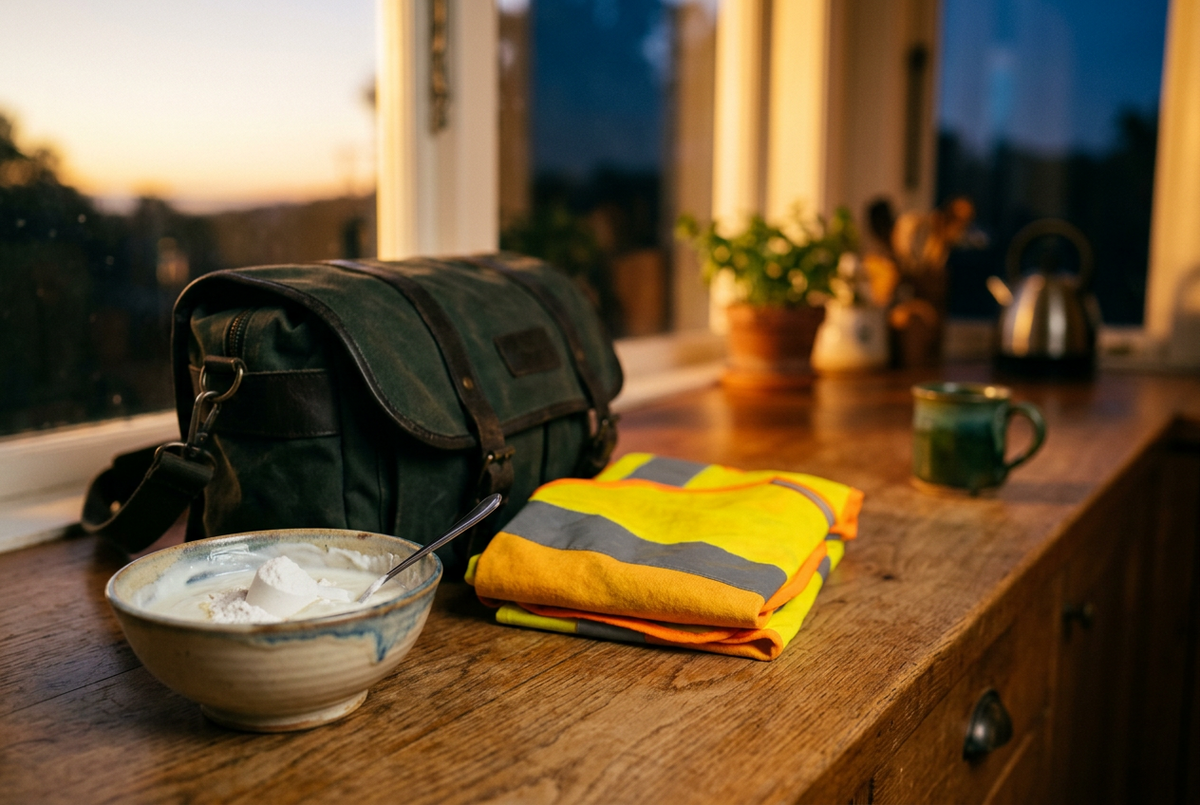
- Anchor it to a meal you never skip. For most shift workers that's the meal before you leave for work. Stir it into yoghurt or a shake in a shaker bottle you keep in your bag.
- Don't copy the single megadose. The 16–28 g doses were tested once, in a lab, under supervision. Until there's longer-term data, I wouldn't make that a night-shift habit.
- Fix the basics first. Creatine doesn't replace sleep, food timing or hydration. My night shift eating rules will do more for 3am than any powder.
The honest limitations
The sleep-deprivation results come from one research group, small groups of healthy volunteers, one night of sleep loss and lab-based tests. We don't yet know whether everyday 3–5 g doses give a similar benefit on night shifts, or what happens with repeated large doses over months. Treat this as a promising lead, not a performance guarantee.
Want your plan built around your roster?
Supplements are the last 5%. The first 95% is getting protein, meals and training to fit shifts that change every week. That's exactly what I do with BioFit coaching clients. Book a free consultation and we'll look at your roster together. No obligation.
Sources
- Gordji-Nejad A, et al. Single dose creatine improves cognitive performance and induces changes in cerebral high energy phosphates during sleep deprivation. Sci Rep. 2024;14:4937. doi:10.1038/s41598-024-54249-9
- Gordji-Nejad A, et al. Single-dose creatine reduces sleep deprivation-induced deterioration in cognitive performance. Nutrients. 2026;18(8):1192. doi:10.3390/nu18081192
- Antonio J, et al. Common questions and misconceptions about creatine supplementation: what does the scientific evidence really show? J Int Soc Sports Nutr. 2021;18:13. doi:10.1186/s12970-021-00412-w
- Antonio J, et al. Part II. Common questions and misconceptions about creatine supplementation. J Int Soc Sports Nutr. 2024;22(1):2441760. doi:10.1080/15502783.2024.2441760