
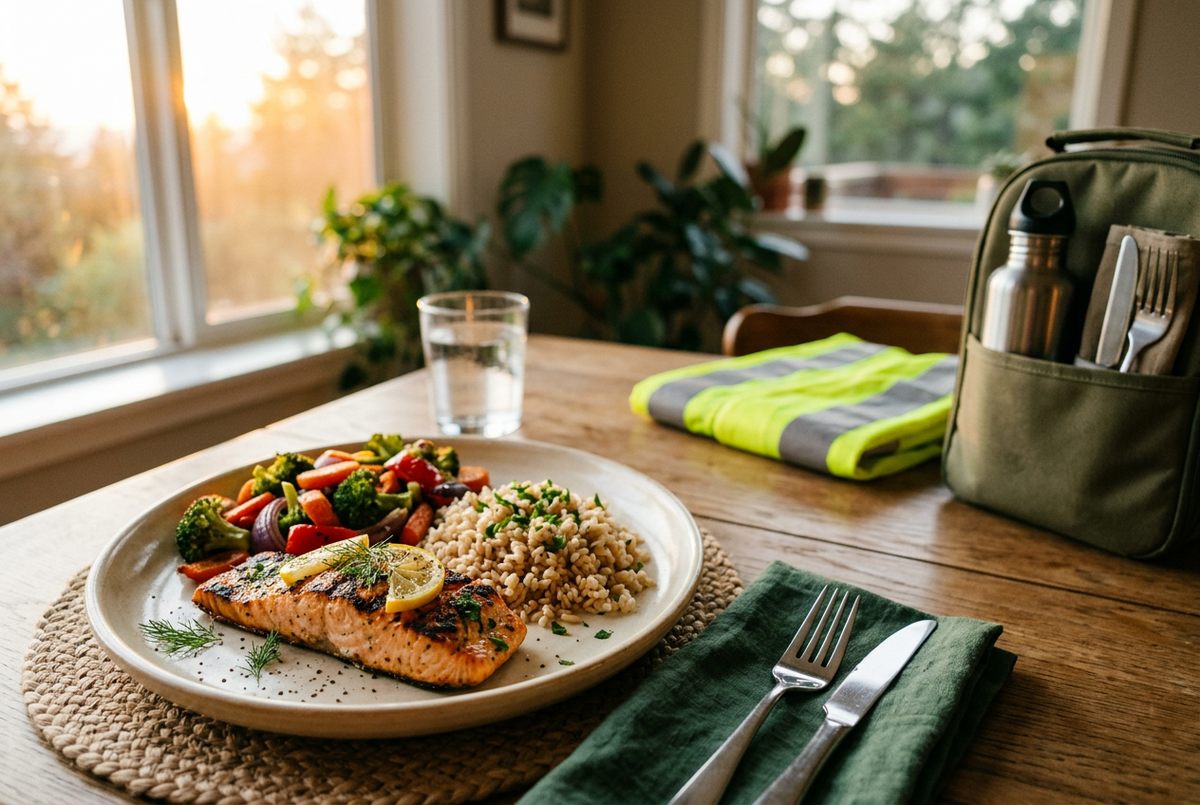
I'm a biotechnologist, and I also work rotating 12-hour shifts. So I've watched it happen on my own scales and heard it from almost everyone on nights: night shift weight gain creeps in even when you swear you're eating the same. The usual explanation is willpower, vending machines and too much takeaway. That's part of it. But the lab studies tell a more interesting story: your body clock changes the maths.
As an Amazon Associate I earn from qualifying purchases. It doesn't change what I recommend.
General information, not medical advice. If your weight has changed quickly or you're worried about your health, see your GP.
The problem: same food, different result
Large population studies agree that shift work and weight go together. A 2018 meta-analysis pooled 26 studies with more than 311,000 people and found shift workers had about a 25% higher risk of being overweight and a 17% higher risk of obesity than day workers.
Those are observational studies, so they can't prove the roster itself is the cause. Shift workers often sleep less, have less time to cook and train, and work in jobs with limited food options. That's exactly why the controlled lab studies matter: they hold food and activity steady and change only the timing.
If you want the practical meal rules for nights, I covered them in Night Shift Eating: 4 Rules From Australian Research. This article is about the why.
What the body-clock studies show about night shift weight gain
1. You burn slightly less energy on night-shift days
In 2014, researchers at the University of Colorado kept 14 adults in a lab for six days and switched them from day shifts to simulated night shifts, with meals and activity tightly controlled. On the transition day (a nap plus a long stretch awake), energy use actually rose about 4%. But on the second and third night-shift days, total daily energy expenditure dropped by about 3%.
The biggest surprise was sleep. During scheduled daytime sleep, people burned about 12–16% less energy than during normal night-time sleep, even though their sleep was more broken. The body also spent less energy digesting a late dinner on the first night shift.
Three per cent sounds tiny. But it's a quiet, daily nudge in one direction, repeated across every run of nights on a roster.
2. Your fullness signals shift too
A 2009 Harvard study took 10 adults through a 10-day protocol where their "day" was stretched to 28 hours, so they ended up eating and sleeping at every point of the body clock. When eating and sleeping ran about 12 hours out of sync with their internal clock, leptin (a hormone linked to feeling full) fell by 17%, blood glucose rose 6% despite 22% more insulin, and sleep efficiency fell by 20%.
Interestingly, in the Colorado study people reported feeling less hungry on night-shift days, even though leptin dropped. So it isn't as simple as "nights make you starving". The signals your body uses to balance energy in and energy out just aren't lining up the way they do on days.
3. When you eat may matter as much as what you eat
A 2021 study from the same Harvard group ran healthy young adults through a 14-day simulated night-work protocol. One group ate during the night (as most night workers do). The other ate only during the daytime. Night-time eating disrupted the body's glucose rhythm and worsened glucose tolerance. Keeping meals to the daytime prevented that change.
That's a glucose finding, not a weight-loss finding. But it points to the same lever: food timing is something you can actually control on a roster.
The honest limitations
These lab studies are small (10 to roughly 20 people each), short (days, not months), and done in healthy volunteers in a controlled lab, not in a hospital ward or a mine site at 3am. The population studies are much bigger, but they're observational and can't untangle the roster from sleep loss, stress and food access. So the fair summary is: the body clock is a plausible, measurable part of night shift weight gain, not the whole story, and not an excuse to give up.
Practical takeaways: the levers I actually use
Lever 1: Have your biggest meal before the shift
Eat a proper meal in the late afternoon or early evening, before you clock on. That's when your body handles food best on a night-shift day. It also means you're not arriving hungry and grazing from midnight.
Lever 2: Small and light overnight
If you need to eat between midnight and 6am, keep it small: a protein-based snack, fruit, yoghurt, a boiled egg. Pack it so the vending machine isn't your only option. A decent insulated lunch bag with containers makes this far easier on a 12-hour shift.
Lever 3: Protect your daytime sleep
Daytime sleep is where the energy-use drop was biggest, and shorter, broken sleep makes everything harder. Make your room properly dark and quiet: blackout curtains or a contoured sleep mask, plus earplugs. I wrote more about this in Waking Up Tired After Night Shift?
Lever 4: Move on your days off
A 3% dip in daily energy use is small enough that regular movement more than covers it. Walks on days off, two or three short strength sessions a week, and steps on shift all count. Consistency across the whole roster beats a perfect week followed by nothing.
Action step: a one-week night-shift test
On your next run of nights, try this for one block:
- 4–6pm: your main meal, with a palm or two of protein, vegetables and some carbs.
- During the shift: one or two small snacks only, packed from home.
- After the shift: a small breakfast if you're hungry, then straight to a dark room.
- Days off: one walk and one short strength session, scheduled with a time.
Note how your energy and hunger feel by the third night. One block won't change the scales much, but it will show you which lever is easiest for you.
Want a plan that bends around your roster?
I've opened a free 7-day week in my BioFit app. You get short sessions you can drag around your roster when a shift changes, a demo video for every exercise, your workouts and progress logged in one place, and a direct line to message me. It's free, no card, and nothing renews. Start your free 7 days here.
Sources
- McHill AW et al. (2014). Impact of circadian misalignment on energy metabolism during simulated nightshift work. PNAS 111(48):17302–7. doi:10.1073/pnas.1412021111
- Scheer FAJL et al. (2009). Adverse metabolic and cardiovascular consequences of circadian misalignment. PNAS 106(11):4453–8. doi:10.1073/pnas.0808180106
- Chellappa SL et al. (2021). Daytime eating prevents internal circadian misalignment and glucose intolerance in night work. Science Advances 7(49):eabg9910. doi:10.1126/sciadv.abg9910
- Liu Q et al. (2018). Is shift work associated with a higher risk of overweight or obesity? A systematic review and meta-analysis. International Journal of Epidemiology 47(6):1956–71. doi:10.1093/ije/dyy079