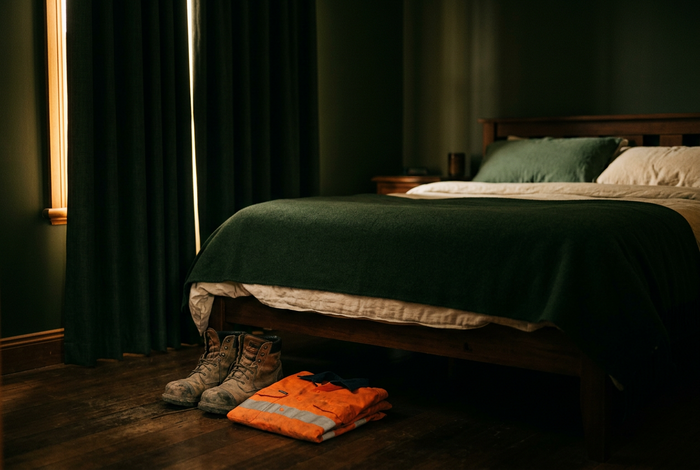
By Hugo Novais, biotechnologist, former professional swimmer and a rotating 12-hour shift worker myself.
As an Amazon Associate I earn from qualifying purchases. It doesn't change what I recommend.
Last night block ended, you finally got a proper sleep, and you still woke up feeling like you'd been hit by a bus. I know that morning well: I work rotating 12-hour shifts, and as a biotechnologist I wanted to know why it happens. Waking up tired after night shift isn't a willpower problem. It's mostly timing: your body clock, the hour you wake up, and the debt you built across the run of nights. Here's what the sleep studies say, and what I actually do about it.
Why you wake up tired after night shift
1. Your body clock didn't come with you
Your brain has a master clock that sets the timing of melatonin, cortisol, body temperature and alertness. A 2021 review of shift-work research found that this clock is stubborn: after several nights in a row, it still hasn't shifted much toward a night schedule. Most of the rhythmic genes measured in the blood stay set to a day schedule, just with flatter rhythms, while many metabolites move by several hours. Different parts of your body end up on different time zones (Boivin et al., 2021).
So when you sleep at 9am, you're asking your body to sleep while its clock is pushing you awake. That's why daytime sleep after nights so often feels lighter and more broken, even when the hours look fine on paper.
2. You're waking up at a bad biological time
The heavy, foggy feeling just after you wake has a name: sleep inertia. A review from fatigue researchers found it's worse when you've already lost sleep, and worse depending on the time of day you wake up. Waking near your body's low point, which after a run of nights can land in strange places, makes it hit harder. The good news is that it fades the longer you're awake (Hilditch & McHill, 2019).
3. One sleep doesn't clear a whole block
Four or five nights of short, broken day sleep add up. Your first "proper" sleep is paying back part of that debt, not all of it, and you're taking it while your clock is halfway between nights and days.
What the research says actually helps
Keep an "anchor sleep"
This is the most useful idea I've found for rotating rosters, and it's older than most of us. In the early 1980s, researchers in Manchester put volunteers on chaotic sleep schedules in an isolation unit. When sleep times were random, their body rhythms drifted. But when people kept just 4 hours of sleep at the same time every day, and took the rest of their sleep whenever, their rhythms settled back to a stable 24-hour cycle within a few days (Minors & Waterhouse, 1981). A follow-up study under tighter lab conditions found the same anchoring effect (Minors & Waterhouse, 1983).
In practice: pick a 4-hour block you can protect on night shifts and days off. For a night worker that might be 8am to 12pm. On nights you sleep roughly 8am to 3pm. On days off you go to bed late and sleep roughly 4am to noon, instead of flipping straight back to a 10pm bedtime. The overlap is your anchor, and it's close to the pattern the light studies below were aiming for.
Control your light: dark on the way home, bright when it counts
Light is the strongest signal your body clock reads. In a set of US trials on simulated night work, people who got short bursts of bright light during the shift, wore dark sunglasses on the way home, slept in a dark bedroom at set times, and got some outdoor light in the afternoon (a "light brake" so they didn't drift too far) reached a compromise body-clock position. Their mood, fatigue and performance on night shift came close to daytime levels, and they still slept well on days off (Smith et al., 2009a; Smith et al., 2009b).
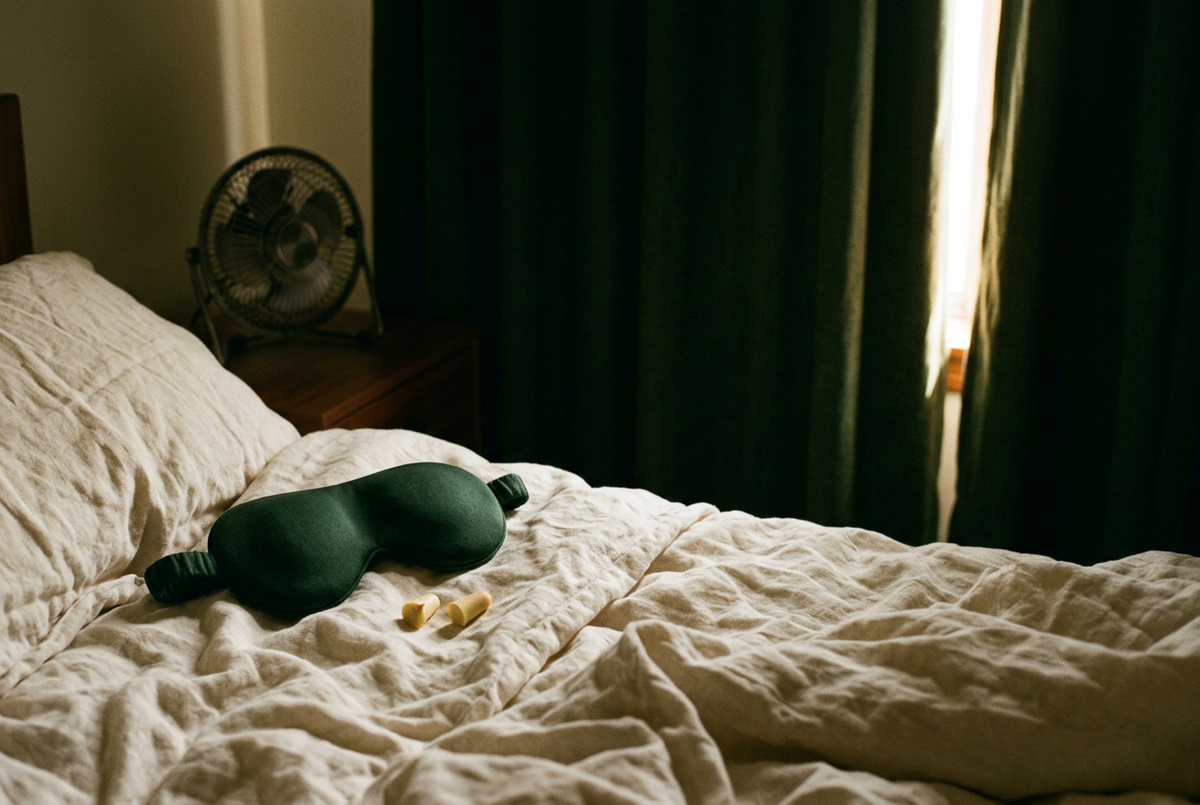
The cheap version for the rest of us: a pair of dark sunglasses for the morning drive (only if it's safe for your eyes and the road), and a bedroom that's truly dark. Blackout curtains or a contoured eye mask does most of the job.
Keep the room cool and quiet
Sydney summers are coming, and that matters for day sleepers. A 2026 systematic review of workers exposed to heat found that hotter nights consistently meant worse and shorter sleep, with night-time temperatures above about 25°C linked to taking longer to fall asleep and sleeping less efficiently. Shift workers were one of the most affected groups (Raja et al., 2026). Close the curtains before you leave for work, run a fan or the air-con, and use foam earplugs against daytime noise.
Respect the grog
Sleep inertia is a safety issue, not only a comfort one. Give yourself a buffer after waking before you drive or do anything risky. Get up, get light, drink water, eat something with protein, and move. If you're ever drowsy at the wheel, pull over. No trick beats that.
An honest limit of the evidence
The anchor-sleep studies were small lab experiments from the 1980s, and the light studies used young, healthy volunteers on simulated permanent night shifts, not real rotating 12-hour rosters with kids, commutes and overtime. The ideas are biologically solid and widely used, but nobody has run a large trial proving that anchor sleep makes rotating shift workers wake up fresher. Treat this as a well-reasoned experiment on yourself, not a guarantee.
My 7-day reset after a run of nights
- Choose your anchor. Write down one 4-hour sleep block that overlaps your night-shift sleep and your days-off sleep. Protect it every day this week.
- Last night shift: sunglasses on the way home, then sleep inside your anchor. When you get up, spend some time outside in afternoon daylight.
- Days off: go to bed later rather than earlier, and keep your anchor hours covered. Need a nap? Keep it under 30 minutes and before mid-afternoon.
- Every sleep: dark, cool and quiet. Phone out of reach.
- Food: a small, protein-based meal before day sleep beats a big greasy one. My four night-shift eating rules cover this, and if you train on your roster, read when to train after a night shift.
If you're exhausted every single day, falling asleep when you don't mean to, or snoring heavily, that's not a body-clock tweak. See your GP. Shift work sleep problems are common and worth checking properly.
Your next step
Everyone's body clock runs a little differently, and your genes, training and food all play into how you cope with nights. My free Biotype Guide is a good place to start working out what suits your biology. Grab it, and if you'd like your sleep, food and training planned around your actual roster, BioFit Coaching is where I do that one on one.
General information, not medical advice. If fatigue persists or you have a health condition, talk to your GP.
Sources
- Boivin DB, Boudreau P, Kosmadopoulos A. Disturbance of the circadian system in shift work and its health impact. J Biol Rhythms. 2021;37(1):3-28. doi:10.1177/07487304211064218
- Hilditch CJ, McHill AW. Sleep inertia: current insights. Nat Sci Sleep. 2019;11:155-165. doi:10.2147/NSS.S188911
- Minors DS, Waterhouse JM. Anchor sleep as a synchronizer of rhythms on abnormal routines. Int J Chronobiol. 1981;7(3):165-188. PubMed 7239725
- Minors DS, Waterhouse JM. Does 'anchor sleep' entrain circadian rhythms? Evidence from constant routine studies. J Physiol. 1983;345:451-467. doi:10.1113/jphysiol.1983.sp014988
- Smith MR, Fogg LF, Eastman CI. Practical interventions to promote circadian adaptation to permanent night shift work: study 4. J Biol Rhythms. 2009;24(2):161-172. doi:10.1177/0748730409332068
- Smith MR, Fogg LF, Eastman CI. A compromise circadian phase position for permanent night work improves mood, fatigue, and performance. Sleep. 2009;32(11):1481-1489. doi:10.1093/sleep/32.11.1481
- Raja M, et al. Impacts of heat on sleep quality among heat-exposed workers: a systematic review. Ann Occup Environ Med. 2026;38:e3. doi:10.35371/aoem.2026.38.e3