
Gut health and sleep: the circadian-microbiome connection nobody talks about
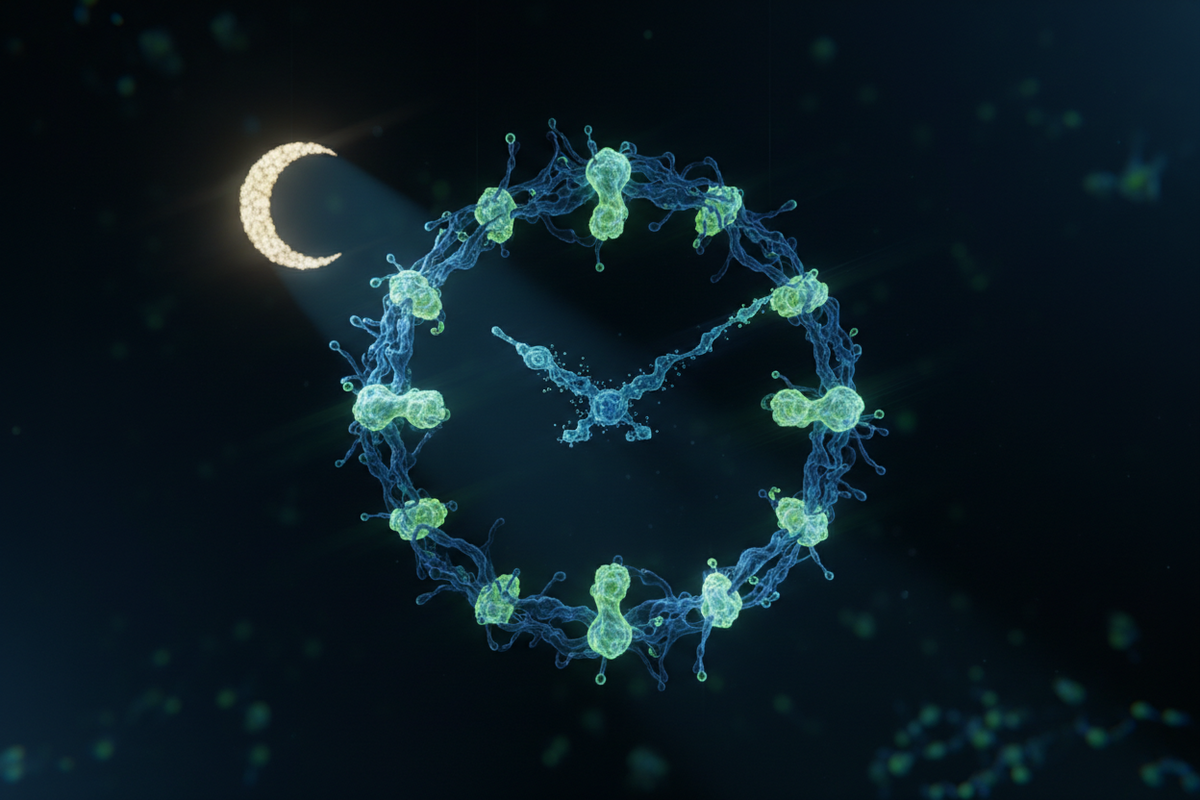
Everyone knows poor sleep makes you feel worse. Fewer people know your gut bacteria run on their own daily clock, one that talks directly to your circadian rhythm in both directions. Disrupt one and you measurably disrupt the other, and the mechanism is better studied than the wellness-content version of this topic usually lets on.
What the research actually shows
Start with the foundational mechanism. A landmark 2014 study in Cell found that gut microbiota composition oscillates diurnally, on the scale of hours, in coordination with feeding patterns and the host circadian clock, in both mice and humans (Thaiss et al., 2014). When the researchers experimentally disrupted circadian rhythm through jet lag, the resulting microbial imbalance produced glucose intolerance and weight gain. The causal proof came from the mouse side of the study, transplanting jet-lagged microbiota into germ-free mice transferred the metabolic problems along with it, but the diurnal oscillation pattern and the jet-lag-associated dysbiosis were also documented directly in human subjects.
On the human sleep-quality side specifically: a 2019 study in PLOS ONE analysed gut microbial diversity in 26 men and found it correlated directly with sleep quality, greater bacterial diversity tracked with higher sleep efficiency and more total sleep time, and with less time spent awake after initially falling asleep (Smith et al., 2019). This isn't circumstantial, it's a direct measured relationship between how diverse your gut community is and how well you actually sleep.
The reverse direction holds too. A 2023 randomised crossover trial in Scientific Reports put 19 healthy men through three nights of severe sleep restriction, just 2 hours per night, against three nights of adequate sleep, with diet and activity controlled. Gut bacterial richness dropped 21% after the sleep-restricted nights (Karl et al., 2023). Three bad nights measurably thinned out the diversity of their gut bacteria. Intestinal permeability wasn't affected in this particular trial, so this isn't evidence of "leaky gut" from short-term sleep loss, but the diversity hit itself was real and statistically significant.
What this means for you
This is a genuine two-way street, not just "sleep affects everything" restated with gut bacteria as the new variable. Consistent meal timing and sleep-wake timing appear to matter specifically because your gut microbiota are entraining to those daily cues, irregular eating and sleeping schedules are a more direct disruptor of gut rhythm than most people assume. And the sleep-quality side works both ways: if your gut health is already compromised, low diversity, recent antibiotic use, chronic gut symptoms, that may be contributing to poor sleep quality independently of typical sleep hygiene factors like screen time or caffeine.
Practically, the actionable version of this research is unglamorous: a consistent sleep-wake window and consistent meal timing, seven days a week rather than a weekday routine and a weekend free-for-all, since the diurnal oscillation pattern responds to consistency, not any single "gut-healthy" food.
Worth knowing why this connection exists at all: the gut is where roughly 95% of the body's serotonin is produced, and serotonin is the direct biochemical precursor to melatonin, the hormone that governs sleep timing. Gut bacteria also influence this pathway through short-chain fatty acid production and by modulating tryptophan availability, the amino acid serotonin is made from. That's the plausible biological link between "gut diversity" and "sleep efficiency" showing up as a real correlation in the human data above, not just two unrelated health metrics that happen to move together.
The biotype angle
Shift workers and anyone with genuinely irregular schedules, disproportionately represented among endomorphs and mesomorphs in physically demanding jobs in my coaching experience, carry the clearest version of this disruption, chronic circadian misalignment plus chronic gut dysbiosis, reinforcing each other. Ectomorphs who tend to skip or delay meals under stress are disrupting the feeding-pattern side of the same clock, even without classic shift-work circadian disruption.
The honest verdict
The mechanism is real and reasonably well-established, this isn't speculative wellness content, it's published in Cell and replicated in human sleep-microbiome studies since. The limitation: we don't yet have strong human RCT evidence that fixing gut diversity directly improves sleep, or that fixing sleep timing directly rebuilds gut diversity, the relationship is well-documented but the interventional proof in humans specifically is still thinner than the observational and mouse-mechanistic evidence. Treat consistent timing as a reasonable, low-cost lever, not a guaranteed fix for either sleep or gut symptoms alone.
For more on how gut health connects to the rest of the body: → 7 Ways Your Gut Health Reaches Your Skin, Joints, and Mood
Want a training and nutrition plan that accounts for your actual daily rhythm, not a generic template?
→ milenium.com.au/pages/biofit-training
References:
1. Thaiss CA, Zeevi D, Levy M, et al. Transkingdom control of microbiota diurnal oscillations promotes metabolic homeostasis. Cell. 2014. DOI: 10.1016/j.cell.2014.09.048. PMID: 25417104.
2. Smith RP, Easson C, Lyle SM, et al. Gut microbiome diversity is associated with sleep physiology in humans. PLOS ONE. 2019. PMID: 31589627.
3. Karl JP, Whitney CC, Wilson MA, et al. Severe, short-term sleep restriction reduces gut microbiota community richness but does not alter intestinal permeability in healthy young men. Sci Rep. 2023. DOI: 10.1038/s41598-023-27463-0.