Affiliate disclosure: As an Amazon Associate, I earn from qualifying purchases. I only recommend products with real scientific evidence behind them, and I'm upfront about where the evidence is thin.
Are cheap carbon fiber paddles actually worth it, or just marketing?
I picked up the VICLION-PADDEX carbon fiber paddle set for the same reason a lot of people looking at pickleball gear do: the price is low, the marketing says "carbon fiber" and "USAPA approved," and it's hard to know from the listing alone whether that translates to anything on court. I've been playing pickleball a few sessions a week for a while now, mostly with paddles from bigger brands, so I wanted to see where a sub-$70 set of two actually lands.
What's actually in it
The VICLION-PADDEX set is two paddles, four balls and a bag for AUD $69.99 — so effectively around $35 per paddle before you even factor in the extras. Each paddle uses a carbon fiber face over a polypropylene (PP) honeycomb core, listed at 14mm thickness with a 4.3-inch grip circumference and a weight around 8.1oz. It's USAPA approved, which means it meets the size, weight and material standards used in sanctioned play — so it's legal for club and tournament courts, not just backyard games. That's a genuine box worth ticking if you're planning to play anywhere organised.
What the research says
There isn't much published biomechanics research specifically on paddle core thickness or face material — that's a gap in the literature, not something I'm going to pretend exists. Where the science is genuinely useful is injury epidemiology, and it's directly relevant to how a paddle like this fits into your game. According to PubMed, a 2024 review in the Journal of the American Academy of Orthopaedic Surgeons found the most common pickleball injuries presenting to emergency departments were muscle strains, joint sprains and fractures, with men three times more likely to sustain strains and sprains than women (Azar et al., J Am Acad Orthop Surg, 2024). A separate NEISS-based analysis of a decade of emergency department data found strains and sprains were the leading diagnosis in senior players, at just over 33% of cases (Weiss et al., Injury Epidemiology, 2021).
Why this matters for a paddle review: grip comfort and vibration dampening aren't just feel-good marketing points, they're connected to how much repetitive shock your wrist and forearm absorb over a session — the same mechanism behind "pickleball elbow," an overuse pattern that shows up constantly in club players. A paddle with a genuinely comfortable, correctly-sized grip is doing real work here, even if no one's run an RCT on this specific paddle.
What I noticed using it
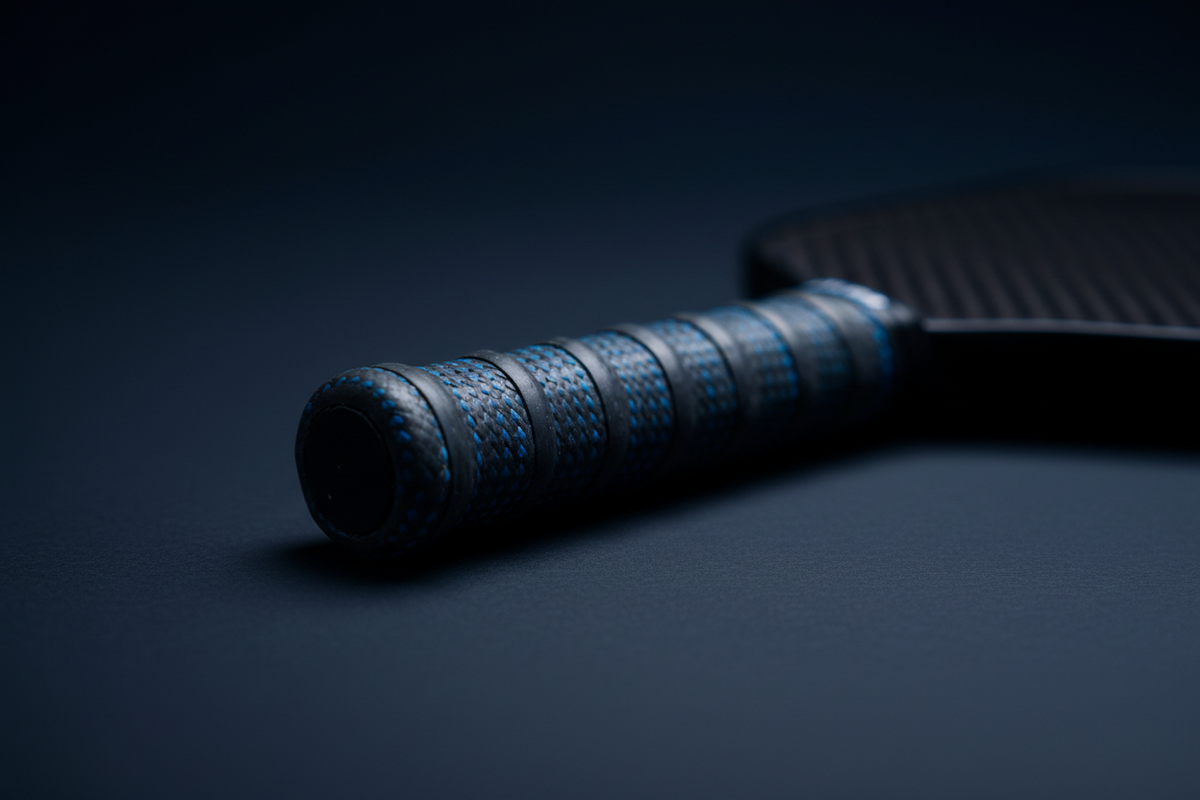
I've had these for about two weeks of regular sessions. The grip is the standout — the 4.3-inch circumference sits well in my hand, and I didn't get the hot, slippery feeling I've had with cheaper paddles after a long rally. No hand fatigue, no re-gripping mid-game. That's not nothing, especially given what the injury research above says about repetitive strain being the most common issue in this sport.
Where it falls short is power. On drives, the ball just doesn't come off the face with the same pace I get from my usual paddle. It's not that it's dead — there's a manageable amount of pop for dinks, resets and control shots — but if you're trying to put real pace on a drive from the baseline, you'll feel the ceiling. The 14mm core is on the thinner side compared to a lot of paddles built for power (many power-oriented paddles run 16mm+), and that likely explains it. Carbon fiber face, yes — but the face material isn't doing all the work; the core matters just as much for how much energy transfers back into the ball.
Who this is actually worth it for
This is squarely an entry-level paddle, and it's honest about that once you actually play with it. If you're an ectomorph or mesomorph biotype just starting out and want something legal for club play that won't punish your wrist while you're learning technique, this set does the job well — the grip comfort genuinely helps early on when your shot mechanics aren't dialled in yet. If you're already playing competitively, or you're an endomorph biotype who tends to rely more on power through the ball rather than finesse, you'll hit the ceiling on drives faster than you'd like.
The honest verdict
For AUD $69.99 for two paddles, four balls and a bag, this is a genuinely reasonable way to start playing pickleball without spending $150+ on a single paddle before you know if you'll stick with the sport. The comfort and control are real, and USAPA approval means you're not locked out of legitimate play. But it is an entry-level paddle, not a hidden gem punching above its price — the lack of drive power is a real limitation, not a nitpick. If you're starting out or buying a backup/guest set, buy it. If you're already playing seriously and want to add pace to your game, this isn't the paddle for that — put the extra money into a paddle with a thicker core built for power instead.
→ Check current price on Amazon AU
If you want a training program built for your biology → milenium.com.au/pages/biofit-training
milenium.com.au/pages/biofit-training
References:
1. Azar FM, Lamplot JD, Bernholt DL, Spence DD. Pickleball: A Standard Review of Injury Prevalence and Prevention in a Rapidly Growing Sport. J Am Acad Orthop Surg. 2024. DOI
2. Weiss H, Dougherty J, DiMaggio C. Non-fatal senior pickleball and tennis-related injuries treated in United States emergency departments, 2010-2019. Injury Epidemiology. 2021. DOI
3. Forrester MB. Pickleball-Related Injuries Treated in Emergency Departments. J Emerg Med. 2019. DOI