
Affiliate disclosure: As an Amazon Associate, I earn from qualifying purchases. I only recommend products with strong scientific evidence behind them or that I've personally tested.
A jump rope is the least glamorous piece of equipment in any gym bag. It also has genuinely solid randomised trial evidence behind it, which is more than most fitness equipment can claim.
I've reviewed PROIRON's resistance bands and foam roller before, so their digital weighted jump rope is a natural extension of a brand I already know does reasonable equipment at a reasonable price point. Here's what the actual training science says about whether jump rope deserves a place in your routine, not just the equipment itself.
What the research actually shows
A 2025 controlled educational intervention published via PMC, involving 52 university students over 8 weeks, tested just 10 minutes of jump rope training once per week, added on top of existing cardiovascular exercise. The jump rope group showed a statistically significant improvement in cardiovascular response (measured via the Ruffier Index) compared to the control group, alongside a substantial increase in lower limb strength (Cohen's d = 1.026, a large effect size) and measurable upper limb strength gains. This is a genuinely low time investment — 10 minutes weekly — producing measurable results in a controlled trial.
A separate randomised controlled trial in middle school students tested jump rope as structured homework, three sessions weekly for 12 weeks, averaging 48 minutes of moderate-to-vigorous activity per session. Compared to a control group receiving health education classes, the jump rope group showed significantly greater improvement in speed, endurance, power, and core muscular endurance. A related trial by Yang et al. found significant improvements in muscular strength, body composition, and bone mineral density in a jump rope intervention group compared to controls — the bone density finding is particularly relevant, since jump rope is a weight-bearing, impact-based activity, and impact loading is one of the more reliable stimuli for bone density adaptation.
A 2019 study published in the European Journal of Applied Physiology, running 12 weeks in teenage girls with prehypertension, found jump rope training positively affected multiple cardiovascular disease risk factors simultaneously: body composition, inflammation markers, blood pressure, and vascular function.
What this means for you
The consistent theme across this evidence: jump rope training delivers a genuinely favourable return relative to time invested. Ten minutes weekly produced measurable cardiovascular and strength effects in a controlled trial — that's a remarkably low bar for a training modality to clear, and it cleared it.
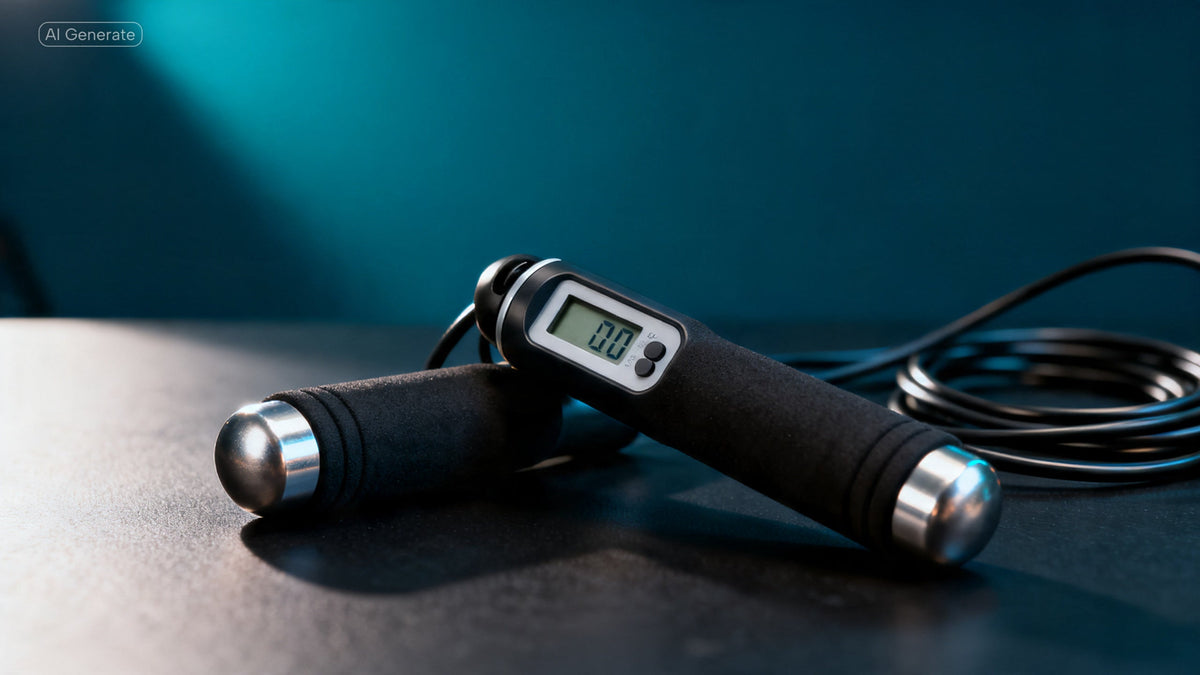
This particular PROIRON model adds a digital counter tracking jump count, time, and estimated calories burned — not essential to the training effect itself, but genuinely useful for progressive overload tracking, since jump rope's main progression variables are session duration and consistency rather than load. The removable weighted handles let you scale resistance, which matters if you're using it for strength adaptation specifically rather than pure cardiovascular conditioning.
One honest caveat: most of the strongest trial data here comes from younger populations — university students and adolescents — rather than older or previously sedentary adults specifically. The mechanism (weight-bearing impact cardiovascular training) is sound and should generalise reasonably, but if you have joint concerns, existing lower-limb injuries, or haven't done impact-based cardio in years, start conservatively and build volume gradually rather than assuming the trial protocols apply identically to your starting point.
Who this is actually worth it for
If you want a genuinely time-efficient cardiovascular and lower-body strength tool that travels anywhere and costs a fraction of most cardio equipment, the evidence supports it clearly. If you're managing existing joint issues or are new to impact training entirely, this isn't necessarily your starting point — build a base with lower-impact cardio first.
The honest verdict
Worth it for the evidence-to-cost-to-time ratio alone. The digital counter is a genuine, if minor, added utility rather than a gimmick, since progression tracking matters for a modality where the main variable is volume over time. Not a replacement for resistance training if your goal is significant strength or hypertrophy — the strength gains documented in the trials are real but modest compared to dedicated resistance training — but as a cardiovascular and coordination tool with genuine bone-density relevance, it earns its place.
→ Check current price on Amazon AU — PROIRON Digital Weighted Jump Rope
Want a training and nutrition program built around your actual biotype — not a generic plan?
→ milenium.com.au/pages/biofit-training
References:
1. Jump Rope Training Improves Muscular Strength and Cardiovascular Fitness in University Students: A Controlled Educational Intervention. PMC12473967
2. Fitness Promotion in a Jump Rope-Based Homework Intervention for Middle School Students: A Randomized Controlled Trial. Frontiers in Psychology, 2022. PMC9244795