As an Amazon Associate I earn from qualifying purchases. It doesn't change what I recommend.
For more than ten years as a competitive swimmer, my day started in the pool before sunrise and often ended there after dark. Between the last session and the first one the next morning sat the longest stretch of the day without food: sleep. Now, as a biotechnologist who reads the protein research for a living, I get asked one question about that stretch more than any other: does eating protein before bed actually build more muscle, or is it just another supplement-industry ritual?
The short answer is that pre-sleep protein does something real inside the muscle overnight. Whether that turns into visible results for you depends mostly on one thing the headlines skip. Let's go through what the trials actually show.
The problem: an 8-hour gap in your protein day
Muscle is constantly being built and broken down. After you train, the building side (muscle protein synthesis) stays switched on for hours, but it needs amino acids from food to keep running. Most people eat their last protein at dinner, then go 10 to 12 hours without any until breakfast. If you train in the evening, which is exactly when a lot of shift workers, parents and office workers can get to the gym, a big part of your recovery window happens while you're asleep and unfed.
So the logic of "protein before bed" is simple: give the muscle raw material during the night, when it's primed to use it. The question is whether the logic survives contact with real people over real training blocks.
What the research says about protein before bed
Inside the muscle, it works. A 2023 randomised controlled trial from Maastricht University had 36 healthy young men do an evening endurance session, then drink 45 g of casein, 45 g of whey or a zero-calorie placebo 30 minutes before sleep. Using stable isotope tracers and muscle biopsies, the researchers found that protein before bed increased overnight muscle protein synthesis, both the contractile (myofibrillar) proteins and the mitochondrial proteins that power endurance work, compared with placebo (Trommelen et al., 2023).
The interesting twist for anyone shopping for a "night-time" protein: casein and whey performed the same. There was no significant difference between them. Casein's reputation as the only bedtime protein isn't supported by this direct comparison.
Over 12 weeks, it added up. The best-known long-term trial randomised 44 young men to a 12-week resistance training program with either a nightly drink of 27.5 g protein plus 15 g carbohydrate, or a non-caloric placebo. The protein group gained more total strength (+164 kg versus +130 kg across their lifts), nearly double the increase in quadriceps cross-sectional area (+8.4 cm² versus +4.8 cm²), and more growth in fast-twitch (type II) muscle fibres (Snijders et al., 2015).
But it's not magic for recovery. This is the one that caught my attention as a former swimmer. A 2023 trial gave trained swimmers either protein (0.5 g per kg of body weight) or the same amount of carbohydrate before bed every night during two weeks of brutal sprint interval work in the pool. Pre-sleep protein did not reduce blood markers of muscle damage or change the inflammatory response compared with carbohydrate. Both groups adapted similarly (Wu et al., 2023).
And it won't "boost your metabolism" either. A 2021 systematic review of 11 studies found limited to no effect of 24–48 g of casein before sleep on energy expenditure, fat burning or next-day appetite (Dela Cruz & Kahan, 2021). That's actually useful news: a bedtime snack of this size doesn't appear to wreck your appetite for breakfast or blunt fat metabolism.
The honest limitation
In the 12-week trial, the placebo group got no extra protein at all. That means the protein group didn't just eat protein at a different time, they ate more protein overall. So we can't cleanly separate "timing" from "total". Add in that most of these trials are small and mostly done in young men, and the fair reading is this: pre-sleep protein is a very effective way to raise your daily total, and there's plausible extra benefit from the timing itself, but the timing effect alone isn't proven.
Practical takeaways
- Get your daily total right first. If you're already hitting your protein target spread across three or four meals, a bedtime serve is a small refinement. If you're falling short, it's one of the easiest ways to close the gap. (I covered how to spread protein across the day in Does Protein Timing Matter?)
- Aim for roughly 30–40 g, 30–60 minutes before bed. The trials used 27.5–45 g. Most people don't need the top end.
- Whey, casein or real food all work. Casein's practical edge is texture: it thickens into a pudding and feels like a proper snack. If you prefer a powder, a well-reviewed option is Optimum Nutrition Gold Standard 100% Casein, mixed in a BlenderBottle Classic shaker so it doesn't go lumpy.
- It matters most on training days, especially if you train in the evening.
- Don't expect it to fix soreness. The swimmer data says sleep, training load and total intake matter more.
Recipe: the cottage cheese night bowl
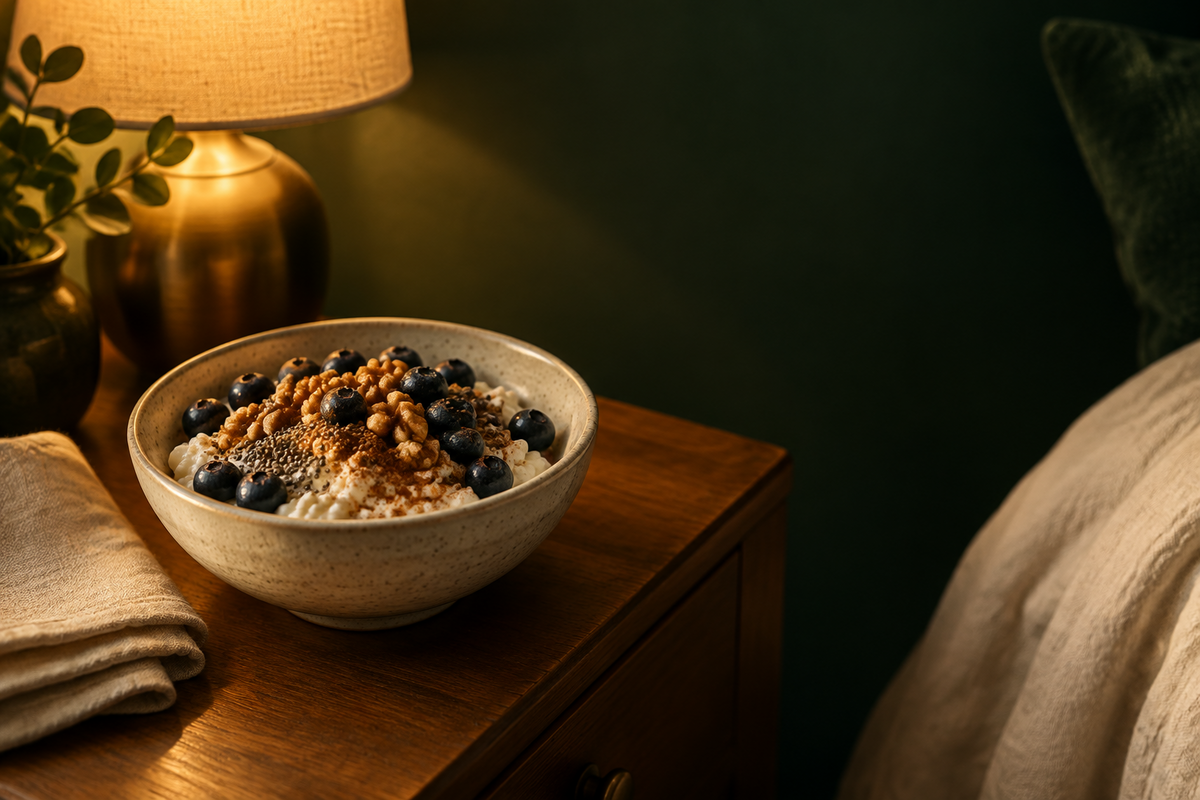
Here's the whole-food version, and the one I actually prefer. Cottage cheese is mostly casein, and a small 2018 randomised crossover trial in active women found that 30 g of protein from cottage cheese before bed had the same effect on next-morning resting energy expenditure and hunger as a matched casein shake (Leyh et al., 2018). In other words, real food does the job.
Makes 1 bowl · about 25–30 g protein (check your brand's label)
- 250 g cottage cheese (regular or reduced-fat)
- 1 small handful of blueberries or frozen mixed berries
- 1 tsp chia seeds
- A few walnut halves, roughly broken
- Generous pinch of cinnamon
- Optional: 1 tsp honey, or a scoop of vanilla casein stirred through for an extra 20+ g protein and a mousse-like texture
Spoon the cottage cheese into a bowl, top with berries, chia and walnuts, and finish with cinnamon. Two minutes, no cooking. If you're tracking portions, a basic digital kitchen scale makes hitting your protein number far less of a guess.
This is general information, not medical advice. If you have kidney disease or have been told to limit protein, talk to your doctor before increasing your intake.
The bottom line
Protein before bed switches on muscle building overnight, whey and casein work equally well, and over a 12-week training block it produced more muscle and strength than a placebo. The catch is that most of that benefit may simply come from eating more protein in total. So treat your bedtime bowl as a convenient, well-tolerated way to hit your daily number, not a secret weapon.
Want your protein target, meal timing and training days built around your own biology, instead of a generic number? That's exactly what the BioType Nutrition Blueprint does.
→ See the Nutrition Blueprint
Sources
- Trommelen J, van Lieshout GAA, Pabla P, et al. Pre-sleep protein ingestion increases mitochondrial protein synthesis rates during overnight recovery from endurance exercise: a randomized controlled trial. Sports Medicine. 2023;53(7):1445–1455. doi.org/10.1007/s40279-023-01822-3
- Snijders T, Res PT, Smeets JSJ, et al. Protein ingestion before sleep increases muscle mass and strength gains during prolonged resistance-type exercise training in healthy young men. Journal of Nutrition. 2015;145(6):1178–1184. doi.org/10.3945/jn.114.208371
- Wu C, Deng J, Gao C. Effects of pre-sleep protein supplementation on plasma markers of muscle damage and inflammatory cytokines resulting from sprint interval training in trained swimmers. Journal of the International Society of Sports Nutrition. 2023;20(1):2244478. doi.org/10.1080/15502783.2023.2244478
- Dela Cruz J, Kahan D. Pre-sleep casein supplementation, metabolism, and appetite: a systematic review. Nutrients. 2021;13(6):1872. doi.org/10.3390/nu13061872
- Leyh SM, Willingham BD, Baur DA, et al. Pre-sleep protein in casein supplement or whole-food form has no impact on resting energy expenditure or hunger in women. British Journal of Nutrition. 2018;120(9):988–994. doi.org/10.1017/S0007114518002416
Research sourced via PubMed.