
"Your legs weaken first": what the research actually says about aging muscle
Dr. William Li's framing that legs are where age-related decline shows up earliest isn't just a memorable line, it lines up with a genuinely interesting shift in how researchers now measure muscle aging. The old marker, grip strength, is being replaced by leg-specific measures, and the food research on what actually helps is more specific than "eat more protein."
What the research actually shows
Start with why legs specifically. A 2025 study in Clinical Nutrition ESPEN followed 868 community-dwelling adults over 65 for 12 years, measuring both traditional grip strength and leg-specific muscle quality markers, phase angle and the extracellular-to-intracellular water ratio in the legs. The result was striking: lower leg muscle quality and slower walking and chair-stand times significantly predicted all-cause mortality, but hand grip strength showed no association with mortality at all in this cohort (Asano et al., 2025). Legs, not hands, carried the actual mortality signal. That's a real finding worth taking seriously, not just a catchy framing device.
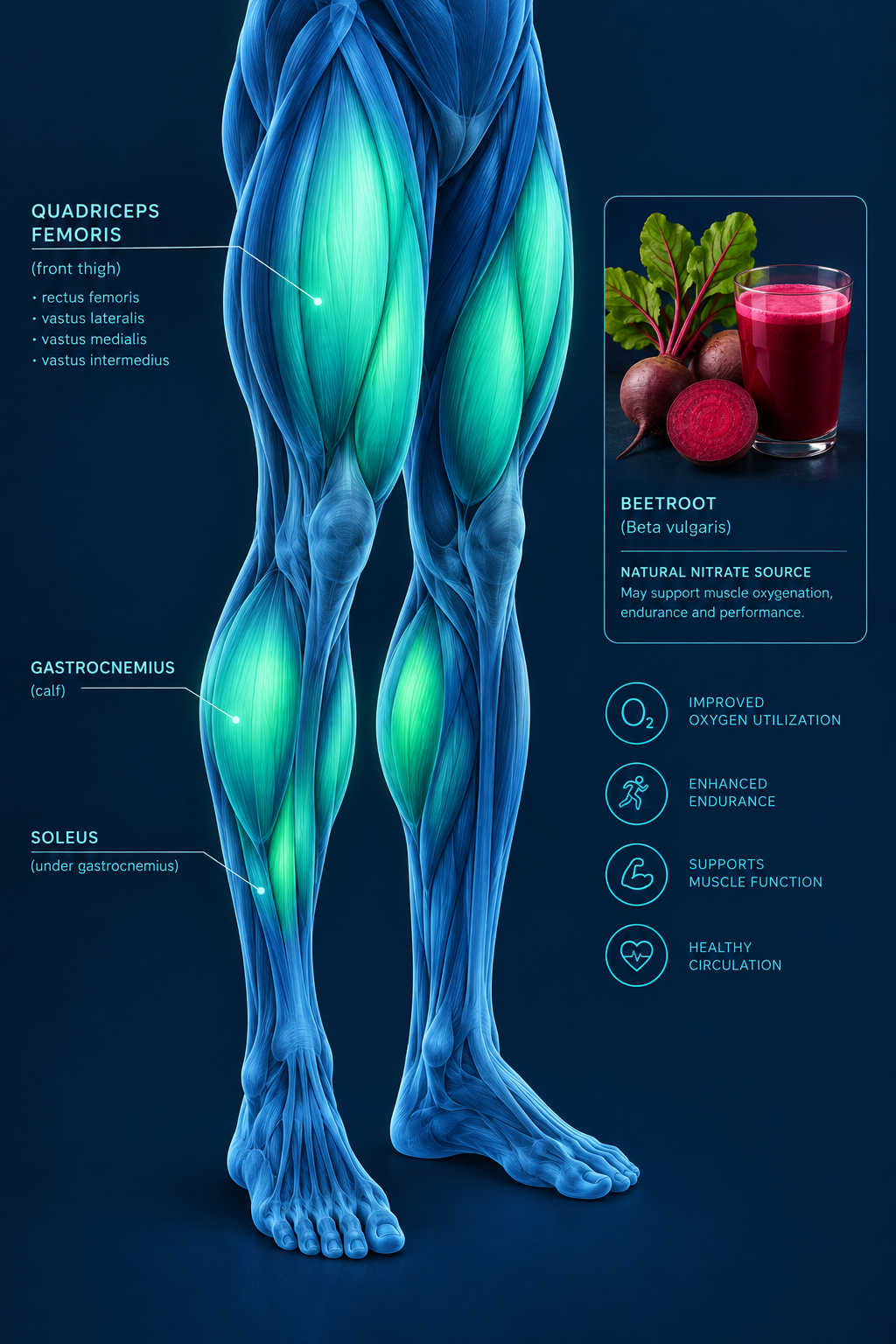
On what specifically helps leg muscle function in older adults: a 2025 randomised trial in Medicine & Science in Sports & Exercise gave 11 older adults (mean age 69) and 11 younger adults nitrate-rich beetroot juice or a placebo for seven days, then tested calf muscle contractile function directly. In the older group only, beetroot juice significantly improved fatigue resistance, time to exhaustion increased by an average of 32 seconds, and improved submaximal force production, effects that did not appear in the younger group at all (Rasica et al., 2025). Aging muscle specifically benefited from the nitrate; young muscle didn't need the help. A 2026 review in the International Journal of Molecular Sciences explains the mechanism: nitrate-rich vegetables restore nitric oxide availability that declines with age-related endothelial dysfunction, improving blood flow and oxygenation to working muscle (Kurhaluk et al., 2026).
Apples specifically come up in this research too, via ursolic acid, a compound concentrated in apple peel. A systematic review in Obesity Reviews covering both animal and human studies found ursolic acid was associated with increased skeletal muscle mass through effects on growth hormone and IGF-1 signalling, and improved measures of physical fitness in the studies reviewed (Katashima et al., 2017). Worth being honest about this one specifically: most of the strongest mechanistic evidence here is still in animal models, and the human data, while promising, is thinner than the beetroot-juice trial above. This is a "worth including, not yet proven at the RCT level in humans" pick, not a settled one.
What this means for you
If you want one measurable check on this, don't just track grip strength, time your walking pace or a sit-to-stand test occasionally, that's the marker the 2025 mortality data actually flagged, not hand strength. On the food side, beetroot juice or whole beets a few times a week has genuine, specific trial support for older adults, one of a small number of foods where the research shows it does more for aging muscle than for young muscle. Apples with the peel on are a reasonable, low-effort inclusion given the ursolic acid mechanism, just don't treat it as equivalent to the beetroot evidence yet.
The biotype angle
This applies most directly to anyone over 50 regardless of biotype, since leg-specific decline is an aging pattern, not a body-composition one. Ectomorphs and anyone with lower overall muscle mass to begin with have the least buffer before leg-specific decline becomes functionally noticeable, worth prioritising leg-focused resistance work specifically, not just general training volume. Mesomorphs and endomorphs with more baseline muscle mass still benefit from the same nitrate and walking-pace tracking, the mortality signal in the research wasn't limited to any particular body type.
The honest verdict
The "legs first" framing holds up better than most one-line health claims do, a real 12-year mortality study backs the leg-over-grip-strength point specifically. The beetroot juice finding is a genuinely well-designed human RCT with a clear, age-specific effect. The ursolic acid piece is real but earlier-stage, promising mechanism, thinner human proof. Track your walking pace occasionally, eat beets a few times a week if you're over 50, and don't oversell the apple-peel piece beyond what it currently is.
For the resistance-training side of preserving muscle with age: → If You Only Take 3 Supplements, Make Them These
Want a training plan that specifically addresses leg strength and muscle preservation as you age?
→ milenium.com.au/pages/biofit-training
References:
1. Asano Y, Tsunoda K, Nagata K, et al. Association of muscle mass, muscle quality, and function with mortality in community-dwelling older adults. Clin Nutr ESPEN. 2025. DOI: 10.1016/j.clnesp.2025.09.022. PMID: 41022180.
2. Rasica L, Colosio M, Ferri A, et al. BEETter AGING: Short-Term Dietary Nitrate Supplementation Enhances Muscle Contractile Properties in Older But Not in Young Adults. Med Sci Sports Exerc. 2025. DOI: 10.1249/MSS.0000000000003708. PMID: 40098056.
3. Kurhaluk N, Kołodziejska R, Buyun L, Kamiński P, Tkaczenko H. Dietary Nitrate-Rich Vegetables as Natural Modulators of Health: Mechanisms and Benefits in Ageing Populations. Int J Mol Sci. 2026. DOI: 10.3390/ijms27083461. PMID: 42074104.
4. Katashima CK, Silva VR, Gomes TL, Pichard C, Pimentel GD. Ursolic acid and mechanisms of actions on adipose and muscle tissue: a systematic review. Obes Rev. 2017. DOI: 10.1111/obr.12523. PMID: 28335087.