
4 "healthy" foods worth dropping after 50, and why age changes the math
These four foods aren't unhealthy in general. The problem is specific to what your body needs differently after 50: more protein per meal, less tolerance for sodium swings, and a gut and glucose system that responds differently to certain "diet" substitutes than it did at 30. This isn't a label-reading issue, it's a changed-physiology issue.
What the research actually shows
Start with the classic low-protein breakfast, cereal, toast, juice. A 2025 harmonised analysis of eight studies in Clinical Nutrition, pooling 814 community-dwelling adults over 55, found protein intake was consistently lowest at breakfast across every intake group studied, and the groups hitting the healthiest total daily protein were specifically the ones eating more than 20g of protein at individual meals, breakfast included, not just spreading a low amount evenly (Koopmans et al., 2025). A low-fat, high-carb breakfast that was a reasonable choice at 30 is actively working against you at 50 if it's the reason you're starting the day near zero protein.
This connects to why protein needs shift at all: a 2018 review in Nutrients on sarcopenia prevention found the evidence now supports 1.0-1.2g of protein per kilogram of bodyweight daily for healthy older adults, meaningfully higher than the standard adult RDA, with protein spread more evenly across meals showing additional benefit for preserving muscle mass and strength (Tessier & Chevalier, 2018). Fat-free flavoured yoghurt fits the same pattern as the low-protein breakfast: it's marketed as the "light" choice, but it typically delivers less protein and less calcium per serving than a plain full-fat or Greek yoghurt, at a life stage where both matter measurably more for bone and muscle maintenance.
Diet soda and "zero sugar" drinks sweetened with saccharin or sucralose are the least intuitive one. A 2022 randomised controlled trial in Cell, testing four non-nutritive sweeteners in 120 healthy adults over two weeks, found saccharin and sucralose specifically impaired glycemic responses through microbiome-mediated effects, and the degree of impairment tracked with each person's individual gut microbial composition (Suez et al., 2022). Glucose regulation already trends toward less resilience with age, adding a sweetener shown to independently disrupt it in a controlled trial is working against a system you want functioning well, not against it.
High-sodium canned and packaged "heart-healthy" soups round out the list. Salt sensitivity, how much a given sodium load actually raises your blood pressure, is well documented to affect roughly 50% of people with hypertension and around 25% of people with normal blood pressure, with age one of the established contributing factors according to a 2025 review of the central nervous system mechanisms behind salt-sensitive hypertension (Feng Earley et al., 2025). A soup can labelled "heart-healthy" that still carries 700-900mg of sodium per serving is a meaningfully bigger blood-pressure risk at 55 than it was at 30, even if nothing else about your diet changed.
What this means for you
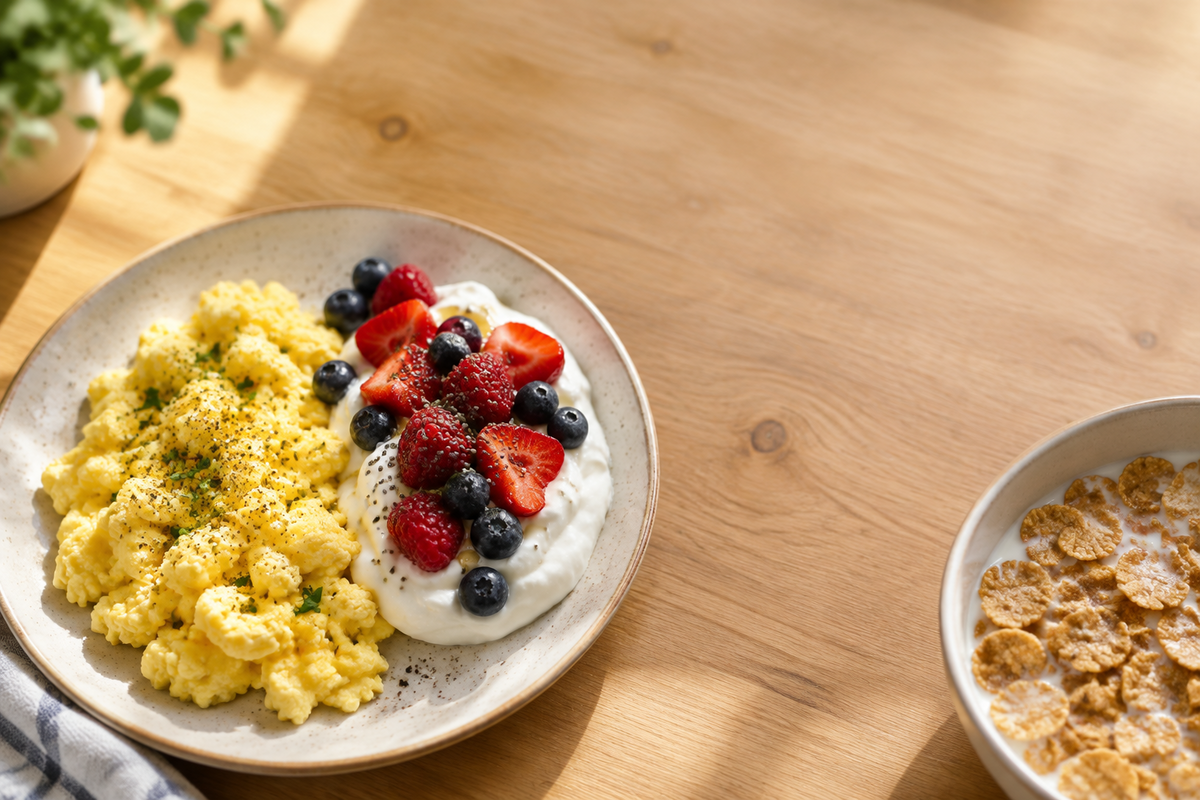
None of these require elimination, they need a swap. Add eggs, Greek yoghurt, or a protein shake to breakfast instead of relying on cereal or toast alone. Choose plain full-fat or high-protein Greek yoghurt over fat-free flavoured versions. Default to water, unsweetened tea, or black coffee over diet soda as your everyday drink. Check the sodium line on packaged soups and favour the lower-sodium or "no added salt" version, or a homemade version where you control it directly.
The biotype angle
Ectomorphs are the group most likely to be under-eating protein overall, and the breakfast gap specifically compounds that shortfall across the whole day. Endomorphs managing blood pressure or metabolic health are the group where the diet soda and high-sodium soup swaps matter most directly. Mesomorphs in heavy training should treat the higher protein target, 1.0-1.2g/kg as a floor, not a ceiling, training itself raises protein needs further on top of the age-related increase.
The honest verdict
These four foods aren't dangerous, and none of this is about fear. It's that the version of "healthy" that worked at 30, lower fat, lower sugar labels, less red meat, less salt awareness, needs updating once protein requirements rise and glucose and blood-pressure regulation both become less forgiving. Swap deliberately, not out of anxiety about any single food.
For the deeper dive on protein needs specifically: → If You Only Take 3 Supplements, Make Them These
Want a nutrition plan built around what your body actually needs at your age and biotype?
→ Get the free Biotype Guide
References:
1. Koopmans L, van Oppenraaij S, Heijmans MWF, et al. Dietary protein intake, protein sources & distribution patterns in community-dwelling older adults: A harmonized analysis of eight studies. Clin Nutr. 2025. DOI: 10.1016/j.clnu.2025.02.022. PMID: 40023943.
2. Tessier AJ, Chevalier S. An Update on Protein, Leucine, Omega-3 Fatty Acids, and Vitamin D in the Prevention and Treatment of Sarcopenia and Functional Decline. Nutrients. 2018. DOI: 10.3390/nu10081099. PMID: 30115829.
3. Suez J, Cohen Y, Valdés-Mas R, et al. Personalized microbiome-driven effects of non-nutritive sweeteners on human glucose tolerance. Cell. 2022. DOI: 10.1016/j.cell.2022.07.016. PMID: 35987213.
4. Feng Earley Y, Pan S, Verma H, et al. Central nervous system mechanisms of salt-sensitive hypertension. Physiol Rev. 2025. DOI: 10.1152/physrev.00035.2024. PMID: 40315132.