The gut-immune axis: how much of your immune system really lives in your gut?
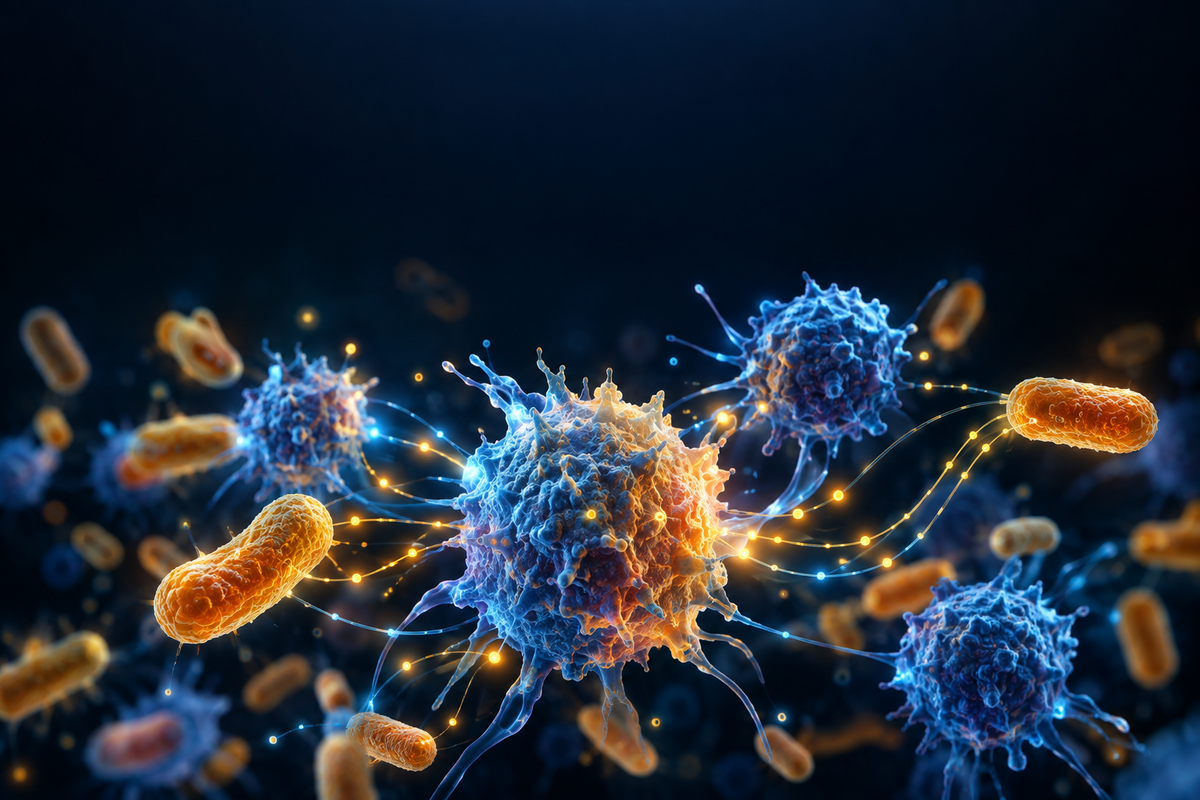
You've probably seen the claim that "70-80% of your immune system lives in your gut." It gets repeated constantly, rarely sourced, and it oversimplifies a genuinely interesting relationship. The more useful, better-evidenced question isn't a percentage, it's this: does the state of your gut microbiome actually change how well your immune system responds to a real threat? With flu season approaching, the answer turns out to be yes, and the mechanism is now mapped in real human trials.
What the research actually shows
The clearest causal evidence comes from a landmark 2019 trial in Cell. According to PubMed, researchers gave healthy adults broad-spectrum antibiotics before and after seasonal influenza vaccination, reducing gut bacterial load roughly 10,000-fold with a long-lasting drop in bacterial diversity. In people with low pre-existing flu antibody levels, this microbiome disruption significantly impaired their antibody and immune response to the vaccine, alongside an inflammatory signature otherwise seen mainly in elderly adults and a 1,000-fold drop in serum secondary bile acids that correlated tightly with that inflammation (Hagan et al., 2019, DOI). This wasn't an association pulled from observational data, the researchers actively disrupted the microbiome and watched the immune response change.
A 2025 follow-up study in Cell Host & Microbe from the same research group tested whether this held for a different vaccine entirely. According to PubMed, antibiotic-induced gut microbiome disruption reduced rabies-specific antibody responses in humans, shifted the immune response toward a more inflammatory T-helper-1-dominant pattern, and again showed major shifts in secondary bile acids as a likely mechanistic link (Feng et al., 2025, DOI). Two different vaccines, two different pathogens, the same gut-microbiome-dependent pattern. That's a meaningfully stronger form of evidence than a single study.
A 2025 review in Gut Microbes pulls this into a broader picture. According to PubMed, the review found consistent human evidence linking gut microbial composition, particularly specific taxa, to vaccine immunogenicity across SARS-CoV-2, hepatitis B, and influenza vaccines, with short-chain fatty acids and bile acids identified as the likely signalling molecules influencing T-cell differentiation and antibody production. It also notes that germ-free and antibiotic-treated animals show diminished vaccine responses experimentally, while microbial-based interventions can enhance them (Decker et al., 2025, DOI). The gut isn't just correlated with immune function, it appears to actively calibrate how strongly your body responds when challenged.
One honest counterpoint worth including: the relationship isn't a simple two-way street. According to PubMed, a 2024 study in Life Science Alliance found the gut microbiome remained remarkably stable after COVID-19 vaccination itself, across healthy and immunocompromised people alike, at every level measured including diversity and species composition (Boston et al., 2024, DOI). Vaccination doesn't meaningfully disrupt your microbiome, but your microbiome's baseline state does appear to influence how well vaccination works. The causal arrow points one direction more strongly than the other.
What this means for you
Skip the "70-80%" statistic, it's not the useful number here. The more actionable fact is that a recent course of antibiotics measurably reduces your capacity to mount a strong antibody response to a vaccine, flu or otherwise, for some meaningful stretch of time afterward. If you're due for a flu shot and you've recently finished antibiotics, timing matters more than most people realise, and rebuilding gut diversity through fiber and fermented foods in the weeks after a course isn't just a digestive-comfort issue, it's plausibly an immune-readiness one too. Outside of antibiotic use, there's no evidence a healthy person needs to actively "boost" gut-immune function beyond ordinary dietary variety and fiber intake, since the disruption studies used a deliberate, aggressive antibiotic intervention, not everyday life.
The biotype angle
This applies evenly across biotypes, since the mechanism runs through gut bacterial diversity and bile acid metabolism rather than body composition. Where it's most relevant in coaching: anyone recently on antibiotics for an unrelated issue, regardless of biotype, going into flu season is the group who should be most deliberate about gut-supportive nutrition and not assume their vaccine response is running at full strength on the usual timeline.
The honest verdict
The gut really does calibrate immune response, but not via a tidy percentage you can quote. The strongest evidence is specific and mechanistic: antibiotic-driven microbiome disruption measurably weakens vaccine antibody responses across at least two different vaccines, likely through reduced bile acid and short-chain fatty acid signalling. That's a real, useful finding. What it doesn't support is a generic "gut health equals stronger immunity" claim untethered from an actual disruption like antibiotics. Know the difference, and time your gut-rebuilding efforts around real disruptions, not as a constant background anxiety.
Want a nutrition and training approach that actually supports your health, not a viral statistic?
→ milenium.com.au/pages/biofit-training
References:
1. Hagan T, Cortese M, Rouphael N, et al. Antibiotics-Driven Gut Microbiome Perturbation Alters Immunity to Vaccines in Humans. Cell. 2019. DOI: 10.1016/j.cell.2019.08.010. PMID: 31491384.
2. Feng Y, de Jong SE, Oliveira APBN, et al. Antibiotic-induced gut microbiome perturbation alters the immune responses to the rabies vaccine. Cell Host Microbe. 2025. DOI: 10.1016/j.chom.2025.03.015. PMID: 40252648.
3. Decker V, Qureshi K, Roberts L, et al. The emerging role of the gut microbiota in vaccination responses. Gut Microbes. 2025. DOI: 10.1080/19490976.2025.2549585. PMID: 40884514.
4. Boston RH, Guan R, Kalmar L, et al. Stability of gut microbiome after COVID-19 vaccination in healthy and immuno-compromised individuals. Life Sci Alliance. 2024. DOI: 10.26508/lsa.202302529. PMID: 38316462.