
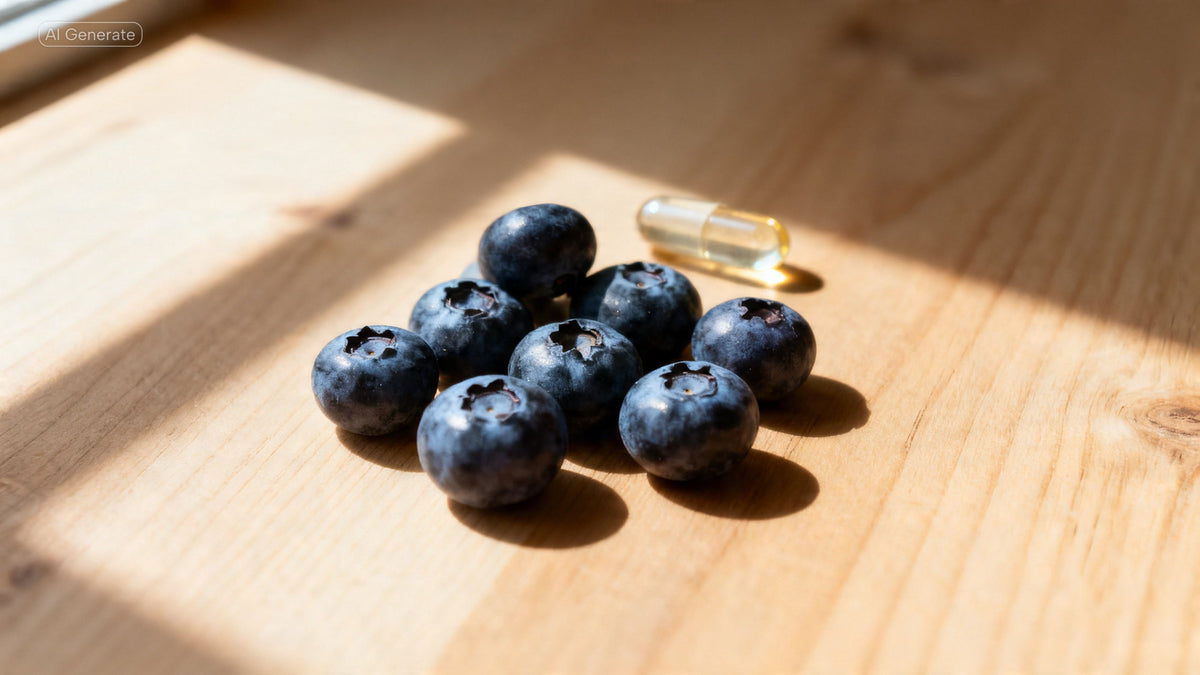
I review supplements for a living. This is the honest version of that job: telling you where whole food genuinely outperforms a capsule, and being straight about the small handful of things it can't.
This is a counterintuitive post to publish from someone whose content regularly features supplement reviews. But the credibility of everything else I write depends on being straight here, not just when it's convenient.
What the research actually shows
The core science concept is called the food matrix effect. A 2017 review by Pressman, Clemens, and Hayes, examining bioavailability of micronutrients from supplements versus food, makes the case directly: nutrients in whole food arrive bundled with cofactors, fibre, and other bioactive compounds that measurably affect how well your body absorbs and uses them — something an isolated capsule can't replicate. This isn't marketing language; it's a documented pharmacokinetic phenomenon with real absorption data behind it.
A 2024 review specifically on anthocyanins — the polyphenols responsible for the deep colour in berries, purple cabbage, and similar foods — found that despite limited direct head-to-head comparisons, the prevailing evidence favours whole-food consumption over isolated anthocyanin extracts for actual bioavailability. The food's fibre and structural matrix appears to protect these compounds through digestion in ways an extract, stripped of that matrix, doesn't replicate as effectively.
This matches a pattern I've written about before with other polyphenol categories: source and delivery format change outcomes as much as the compound itself does. It's not that supplements are inherently inferior — it's that a significant number of plant compounds seem to work better, or at minimum are absorbed differently, in their original food context.
20 plant foods worth building your foundation around
Leafy greens (spinach, kale, silverbeet), cruciferous vegetables (broccoli, cauliflower, brussels sprouts), berries (blueberries, blackberries, raspberries), citrus fruits, kiwifruit, legumes (lentils, chickpeas, black beans), nuts (walnuts, almonds), seeds (chia, flax, pumpkin), whole grains (oats, quinoa, brown rice), fermented vegetables (kimchi, sauerkraut), garlic and onion, turmeric and ginger, avocado, and sweet potato. Each of these delivers a documented nutrient profile inside its natural matrix — fibre, polyphenols, and cofactors working together rather than a single isolated compound working alone.
The three things food genuinely can't replace
Being honest cuts both ways. There are specific nutrients where the evidence clearly favours supplementation over food alone for a meaningful portion of the population, and pretending otherwise would be its own kind of dishonesty.
Vitamin B12 is the clearest case. It's produced by microorganisms, not plants, and is found reliably only in animal products. Multiple nutrition reviews are consistent and direct: vitamin B12 supplementation is essential for anyone following a vegan or largely plant-based diet, full stop — no amount of leafy greens closes this specific gap, because the nutrient simply isn't in plant food in meaningful amounts.
Vitamin D is genuinely difficult to obtain from food alone for almost anyone, vegan or not — dietary sources are limited, and while skin synthesis from sunlight is the primary natural pathway, factors like geographic latitude, skin tone, age, and how much time you spend indoors all limit how reliably that pathway alone covers your needs. This is why supplementation is commonly recommended even for people eating varied, largely animal-inclusive diets, not just those avoiding animal products.
Long-chain omega-3s (EPA and DHA) specifically — not the shorter-chain plant omega-3s in flax or chia, which the body converts to EPA/DHA only inefficiently — are found reliably only in oily fish and algae. If you don't eat fish regularly, an algae-based EPA/DHA supplement is the only realistic route to adequate levels; plant omega-3 sources alone don't reliably close this gap.
What this means for you
The honest framework: build your nutritional foundation from whole plant foods first, where the evidence for food-matrix bioavailability genuinely favours that approach. Then use targeted supplementation specifically for the handful of nutrients — B12, vitamin D, long-chain omega-3s — where the evidence just as clearly says food alone won't reliably get you there. Neither camp has this entirely right on its own; the accurate picture is genuinely both.
The biotype angle
Ectomorphs and anyone eating a largely plant-based diet should treat B12 and long-chain omega-3 supplementation as close to non-negotiable, regardless of how well-constructed the rest of the diet is.
Endomorphs and mesomorphs eating varied diets that include animal products still commonly fall short on vitamin D specifically, given how limited reliable food sources are for everyone — this one isn't a plant-based-diet issue specifically.
Download the free Biotype Guide at milenium.com.au
→ milenium.com.au
References:
1. Pressman P, Clemens RA, Hayes AW. Bioavailability of micronutrients obtained from supplements and food. Journal of Toxicology, 2017. DOI: 10.1177/2397847317696366
2. Bioavailability of Anthocyanins: Whole Foods versus Extracts. PMC11123854